
CONTACT DETAILS
Usability Test for Cash Withdrawal Journey
Summary: Usability test for cash withdrawal journey increase productivity by saving designing time and development effort (reduced Iterations in development process)
Problem Statement:
Mr. Ramesh 52-year-old cab driver in Bangalore. He stays with his wife and two kids, his wife is a homemaker and his kids are studying in college. So Mr. Ramesh is only the earning person in his family. He works very hard from the morning at 6 A.M till night at 10 P.M.
One day he heard from one of his fellow passengers that he can earn more money when he is not working in his work time schedule by the app called Rummycircle. Then he installed that app on his mobile and started playing. Now he is quite happy because his extra earning helps his family a lot.
However, Mr. Ramesh often faces some problems after requesting withdrawal money from his earnings account in Rummycircle.
Some queries he asked the customer care:
"When I will get my money in my bank account ?"
"Will I get an SMS from Rummycicle ?"
"How many days does it generally take?"
"How long I should wait for it?

Based on our internal data, we have observed that 67% of our users are facing the same problem as MR. Ramesh.
So need to create a design solution where the user should understand the approximate time after requesting withdrawal money from his/her Rummycircle account.

My Role & Responsibilities:
UX design and Researcher under the supervision of the Art director. My responsibilities included recruiting participants, designing the user testing for the data visualization piece, facilitator during the workshop, general data collection, analysis, wireframing, and testing.
Challenges:
I have identified some of the major challenges below it:
1. Recruiting participant bais: We needed our participant who will represent Mr. Ramesh's persona, otherwise, we won't get the proper research data so that was a huge challenge for us.
Solution: So we decided some screening Q&A round before User research, which will basically filter out our guanine target user.
2. Time constraints: We had very little time in our hand so there was no option available to conduct a longitudinal research study.
Solution: So I designed our user research plan in such a way that we can get more insight into a small amount of time.
My Approach:
Since we had very less time so for that reason I led this project in a different way with your UX team and sharing the details below:

So after a lot of brainstorming and discussion, we came up with some design solutions.

Games24x7 @2019 copyright - usability testing
Games24x7 @2019 copyright - usability testing

Games24x7 @2019 copyright - usability testing
There was some internal argument with P.M and the Design Team regarding the new element we are adding to our new design:
Option A: ETA
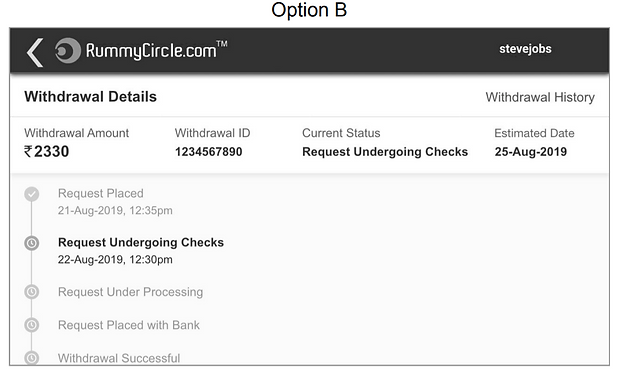
Option B: Estimated Date
Option C: Expected Withdrawal Date
and all options have the same purpose we are giving a rough timeline to our user after requesting his/her withdrawal amount from the Rummycircle app. Then I suggested for formative usability test which will give us a quick insight into which option is perfect for our user.
Purpose:
We need to determine which choice is going to be ideal for the consumer.
Methodology:
What happens during the Formative Usability Testing?
We are conducting two methods to collect qualitative data: 1. Eye Tracking and 2. Observation
At the beginning stage, people generally feel nervous because it's a totally new environment and it will not be a perfect stage if we give the tasks. so I intend to make them comfortable as much as possible, Then I give my introduction with a little smile and I ask them what's their job or profession. hobby? etc. That will create a good bond between the user and me.
Then I introduced our product and gave them the main task to complete that. During this time my job is to observe them and try to understand how hard it is to accomplish the goal whatever we were given by the time and what's their expression, emotions, stress levels, etc. Later on, we asked some follow-up questions which helped us to understand their mental model.
Why Usability Testing?
• Provides validation of design direction.
• Gives you real behavioral insights into how users actually use your site/app.
• Lets you see patterns of use across users and uncover confusions or errors.
• Move beyond the "stupid users" myth to uncover un-intuitive features or functionality.
• Provides insight and empathy for the user's experience to help you fix design errors and issues.
• Industry standard for quality website/ software development: ISO standard ISO/ TR 16982:2002; ISO 9241.
Target user group and place?
We Invited a total of 25 people (persona like: Mr. Ramesh) from Bangalore to our office for the Usability Test with the help of our internal recruitment team and below I am sharing some more details about our target user.


Lab outside view

Room 1 - Research Activity

Room 2 - Observation
Participant Recruitment:
To recruit the user, I gave the details of our target audience to the internal recruitment team, and then they helped at this stage.
Consent and NDA:
Our internal recruitment team sends an email to the participants explaining the purpose of the study before the interviews. At the beginning of the interview session, we repeated the same information to ensure that the participant has understood and consents to participate.
Equipment Need:
A computer with internet access, eye-tracking software, paper, and pen, Lots of Post-it notes, etc.
Conducting Usability Test:
1. We created a Test Task and we have given them some amount in their Rummycircle wallet.
(Scenario: Suppose you were playing RummyCircle and you won Rs.5000, Now you want to withdraw some amount (Rs. 2330) in your bank account from your Rummy wallet.)
2. Next, we asked them to go through with our prototype.
(During the time the user interacts with the prototype observe their expression to make sure how comfortable to use our design.)
3. Parallel we were tracking their eyes.
(Eye-tracking involves measuring either where the eye is focused or the motion of the eye as an individual views a digital screen.)
Purpose of Eye-tracking:
● Where they are looking
● How long they are looking
● How their focus moves from item to item on our design page
● What parts of the interface do they miss?
4. Then after the task, we asked some follow-up questions.
(During this time I followed the "Think-aloud protocol " to understand more about our users and asked some follow-up question like as
" Mr. Ramesh, could you please tell me when you can expect your withdrawal amount into your bank account?
" On this screen which one helps you to understand that? And do you think any other information is helping you with that? anything you found it's difficult to understand? " *
*The above question formation is the main part of this process, It shouldn't be leading to the user instead the tone of question should be neutral.
Test prototype video option-A (Games24x7 @2019 copyright - usability testing)
Data Overviews:
We created 5 user groups with 5 users, then assigned 3 groups for Option-A, Option-B, and Option-C, next we eliminated the most less likable design or option (based on usability matrics) and assigned another 2 groups with rest two options just to revalidate the final design or option. I am sharing below information visualization below to grasp it better.


Option A: ETA, Option B: Estimated Date, Option C: Expected Withdrawal Date

Why users do prefer Option B?

*Please note: UX is contextual so based on research and data it defines that our user likes this option.


Heatmap Analysis:
Through this method, we tried to catch the unconscious behavior of the user like eye movement and confirm with what they were saying at the time of the user interview, and we were not even sure about our layout and location of the Expected Date. But after the heatmap analysis, we understood how our user reading on this screen and below I am sharing the most common eye-tracking information.
This video clip is a gaze replay — it shows how one participant’s eye processed a page on this page.
Conclusion & Closing Thoughts:
This is the project I completely led under Art director so I was quite anxious and excited before beginning the Usability Test, I faced some challenges but my experience and leadership skills help me run this smoothly. The time of user research I have interacted with real users to understand their pain points which helps me to create better a customer-centric design. Even I made some mistakes also which I realized later in the whole journey of Usability Testing to design process but I believe this helps me to make a better version of Udit. Lastly, I am delighted that this project has had a positive effect on the company by increasing productivity by saving designing time and development effort.
Thank you for your time :)